
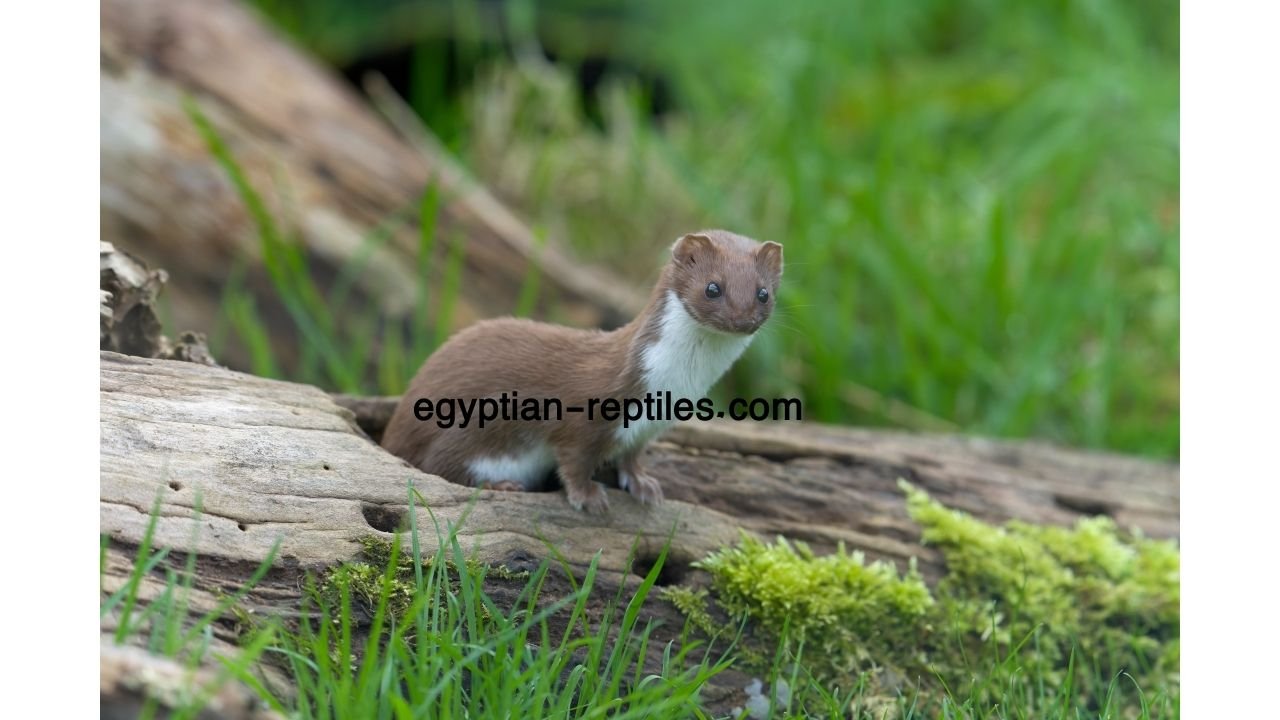
About the Egyptian weasel
Mustela subpalmata, the Egyptian weasel, is found only in northern Egypt: the Nile Delta, Cairo, Alexandria and the valley a little way south. Unlike most weasels it lives right alongside people, in houses, markets and gardens, and hunts mice and rats at night. Some authors treat it as a population of the least weasel (Mustela nivalis), so you will see both names.
Identification

A long, low, short-legged animal with a small flat head and round ears. Adults are roughly 33 to 43 cm long, with a slim tail of about 9 to 13 cm. Males weigh around 60 to 130 g and females are lighter. The back is chestnut brown and the underside is cream, often with brown spots.
Behaviour and diet
Fast, curious and bold. Egyptian weasels are mainly active at night. In towns they eat rodents, insects, small birds, fruit and whatever food people leave out. In captivity they need a meat-based diet: whole prey such as mice and chicks, a quality raw or ferret-type food, and insects for variety, with fresh water always available.
Is it right for you?
This is a small wild carnivore, not a ferret. It needs a tall, very secure enclosure with tunnels, branches and several nest boxes, because a weasel fits through any gap its head fits through. Room temperature of 18 to 28°C suits it. Animals that are worked with daily from a young age become confident around their keeper, but they keep a strong bite and a musky scent. It suits experienced exotic mammal keepers.
Conservation
IUCN Red List: Least Concern.
Export from Egypt and shipping
- CITES: Mustela subpalmata is not listed in the CITES appendices, so no CITES permit is involved.
- Our side: we prepare the Egyptian export documents and the veterinary health certificate for each shipment.
- Your side: the import permit and any rabies, quarantine or exotic-mammal rules in your country. Many countries restrict or ban wild mustelids, so check with your authority before you order.
- Transport: live-animal air cargo in a ventilated crate built to IATA Live Animals Regulations.
- Price: quoted per shipment once we know the destination airport, since freight and paperwork differ from country to country.
Email the species name (Mustela subpalmata), the quantity and your destination country to info@egyptian-reptiles.com, or read the shipping policy first.
More desert mammals from Egypt: Fennec fox (Vulpes zerda), plus care guides for the long-eared hedgehog and the lesser Egyptian jerboa.


